
Think a Great Product Sells Itself? Why Your Packaging Matters More Than You Think
The Myth: “A Great Product Sells Itself”
Have you ever looked at your product and thought, "If people would just try it, they'd love it"? You're probably right. However, getting someone to try your product in the first place is often much more challenging than creating an excellent product.
Many product founders believe that if they focus on making the best possible product, sales will naturally follow. But if your goals include getting more retail shelf space, expanding your wholesale accounts, or increasing sales on platforms like Amazon, this belief can quietly hold you back.
The truth is that customers don't buy products simply because they're great. They buy products they understand, trust, and believe will enhance their lives. And this is an important distinction.
In this article, we'll explore why the idea that "a great product sells itself" is so easy to believe, how it may be slowing your growth, and what actually influences purchasing decisions in retail environments. You'll also learn how to make your product easier for both shoppers and retailers to choose.
Ready? Let's jump in.
Why So Many Founders Believe This Myth
A big reason this myth persists is that founders are constantly surrounded by stories that seem to prove it's true.
You hear things like:
"Our product went viral."
"Word-of-mouth exploded."
"We sold out immediately."
"People can't stop talking about it."
"Just make something amazing."
The message is always the same: the product won because it was great. But that's only part of the story.
What often gets left out is everything that helped people notice, understand, trust, and try the product before they experienced its quality. It's easy to assume that quality alone drove the success. In reality, there were usually dozens of factors that helped customers understand the product's value long before they purchased it.
So if you've believed that a great product should naturally sell itself, you're certainly not alone. It's a common idea in the product world.
The Hidden Cost of Believing a Great Product Sells Itself
The issue isn’t that great products can’t succeed; the problem is that customers often don’t recognize a product as great until after they’ve brought it home.
Think about it. Before purchase, shoppers can't:
Taste the caramel.
Feel the fabric.
Experience the results of the supplement.
See how much easier the tool makes their life.
The quality is hidden. All customers have are clues that signal the quality. And the clues come from:
Packaging
Branding
Messaging
Reviews
Merchandising
Presentation
A jewelry organizer is a great example. People don't buy a jewelry organizer because they want another piece of plastic. They buy it because they want necklaces that aren't tangled in a drawer. They want earrings they can find quickly. They want a collection that's organized, visible, and easy to access.
The product itself isn't what they're buying; they are buying the outcome it provides.
When founders believe that quality alone will drive sales, they often focus their energy on improving the product while spending very little time helping customers understand the product.
As a result, they tend to
Refine the formula rather than enhance the packaging.
Add features instead of clarifying benefits.
Assume customers will "get it" rather than make the value clear.
Rely on conversations to explain the product rather than incorporating those explanations into the packaging.
This creates a frustrating situation. The product performs well when the founder is present. At markets, trade shows, and pop-up events, founders can explain the story, answer questions, and highlight benefits. But on a retail shelf, they can't.
The package has to do the talking. And if the package isn't communicating clearly, even an amazing product can struggle to get noticed.
In the next section, let's look at what is actually true and why understanding this can completely change how you approach growth.
What Customers Need Before They Buy
The truth is simple: If customers don't understand why your product matters, they won't buy it—no matter how great it is.
This is something I've seen repeatedly throughout nearly 20 years of designing packaging for major retailers. One thing became very clear: Retailers don't put products on shelves because they're great. They put products on shelves because they believe customers will buy them.
If quality alone determined success, every great product would win. But that's not what happens. The products that get chosen are often the products that communicate their value the fastest.
When a shopper walks down an aisle, they aren't evaluating products the way the founder does. Instead, they're asking questions like:
What is this?
Why would I want it?
How is it different?
What's in it for me?
Why should I choose this over the other options?
If your packaging answers those questions quickly, you're far more likely to earn attention and consideration. If it doesn't, shoppers simply move on.
People rarely buy products for the product itself. They buy for:
Relief
Convenience
Confidence
Status
Comfort
Enjoyment
Health
Simplicity
Nobody buys a candle just because they need wax. Nobody purchases a supplement merely for the bottle. Nobody indulges in gourmet caramel solely for the sugar. They buy based on how they expect their life to feel afterward.
That's the story your packaging needs to tell. When customers can immediately see themselves in the outcome your product provides, everything changes. Shopping becomes easier, Decision-making speeds up, and choosing your product becomes easier.
Help Customers See the Outcome, Not Just the Product
Once you let go of the idea that a great product sells itself, a much more valuable question emerges:
How do I make this easier to choose?
This question leads directly to retail-ready packaging. Instead of focusing exclusively on features, shift your attention to the transformation your product creates.
Ask yourself:
What problem does this solve?
What feeling does it evoke?
What outcome does it help customers achieve?
Why does it matter in their daily life?
Make sure the answers to these questions are clearly reflected through your packaging.
Your packaging should help customers quickly understand:
What the product is.
Who it's for.
Why it matters.
Why it is different.
Why they should choose it.
How One Packaging Change Made the Product Instantly Easier to Understand
One example that illustrates this perfectly is All Hung Up, a mother-daughter-founded business that created a six-tier wall jewelry organizer. When they came to me, they were preparing to package the product in a clear plastic clamshell. The organizer itself was well-designed and solved a real problem. The challenge wasn't the product. The challenge was that shoppers couldn't immediately understand what they were looking at.
When someone looked at the organizer hanging in a plastic package, they saw some plastic bars with holes in them. What they didn't see was the benefits:
They didn't see necklaces neatly displayed, instead of tangled in a drawer.
They didn't see earrings that were easy to find.
They didn't see a collection of jewelry organized beautifully on the wall.
They missed the convenience, simplicity, and satisfaction the product offered.
To address this issue, I recommended switching from the plastic clamshell to a box featuring a large lifestyle photo that showcased the organizer in use. This change allowed shoppers to grasp what the product was immediately, the problem it solved, and how it could fit into their lives.
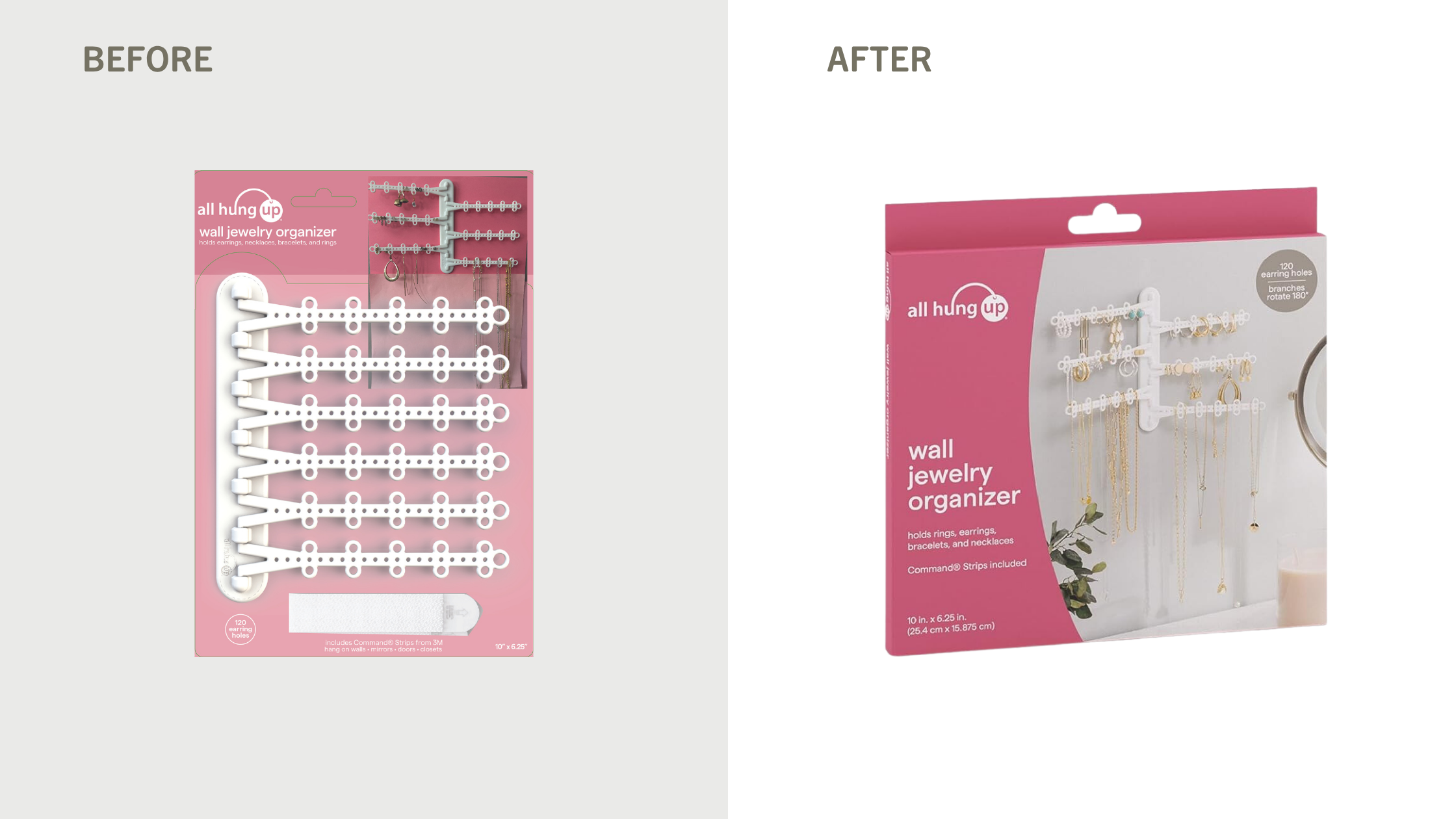
The product itself didn't change. The quality didn't change. What changed was the customer's ability to understand the value. That's often the difference between a product that gets overlooked and a product that gets picked up.
This is exactly what we focus on inside Packaging Pronto. Rather than starting with colors, fonts, or design trends, we begin by identifying the transformation your product creates for customers—not just the features it offers. From there, we turn that transformation into packaging visuals, messaging, and design decisions that are easy for shoppers to understand at a glance.
Our goal isn't simply to create beautiful packaging. It’s to help customers quickly understand what your product is, why it matters, and why they should choose it. Because products that are easy to understand are much more likely to get chosen, and to earn valuable shelf space.
When this happens, you'll notice several benefits:
Shoppers make decisions more quickly.
Retail buyers feel more confident bringing the product into their stores.
Wholesale conversations become easier.
The packaging starts doing part of the selling for you.
You rely less on explanations and founder storytelling.
Ultimately, this leads to a product that is well-positioned to succeed in the market, secure retail placement, and thrive once it gets there.
You Might Be Wondering: “Shouldn't Product Quality Speak for Itself?”
That's a fair question. The answer is yes—but only after the purchase has been made.
Product quality is incredibly important. It drives repeat purchases, turns customers into loyal fans, and generates referrals and positive reviews. However, none of these benefits occur until someone actually buys the product.
Packaging prompts the first purchase, while the quality keeps shoppers coming back for more. Customers can only appreciate the quality of your product after they have made a buying decision. This is why communication matters so much. If people never pick up the product, they'll never discover how great it is.
The Bottom Line
The idea that "a great product sells itself" sounds reasonable, but it overlooks a critical truth: Customers can't evaluate your product's quality before they buy. They can only rely on the clues you give them.
That's why packaging, branding, messaging, and presentation play such an important role in growth. When customers quickly grasp what your product is, why it matters, and how it fits into their lives, they're much more likely to choose it. And when retailers can see that customers will understand the value, they're much more likely to give it shelf space.
So instead of asking, "How can I make my product better?" Try asking:
“How can I make my product easier to understand and easier to choose?”
That shift alone can change how shoppers see your product, and how quickly your business grows.
Ready to Make Your Packaging Work Harder?
If you're trying to get your product onto more shelves, attract wholesale accounts, or create packaging that communicates your value more clearly, I'd love to help.
Learn more about Packaging Pronto at Hidden Path Creative.
Then book a call and let's discuss how to make your packaging easier for shoppers to understand, easier for retailers to say yes to, and better positioned for wholesale growth.