

How to Create Packaging That’s Ready for Retail (Not Just Markets)
You know your product is good.
Customers at markets love it. They stop at your booth, ask questions, smell the candle, test the skincare, or pick up the product because something about it catches their attention. And once you explain it, they usually buy.
But after enough weekends loading inventory into your car, setting up tables before sunrise, standing on your feet all day, and repeating the same explanation hundreds of times, you start realizing something important:
Your business still depends heavily on you being physically present to make sales happen.
That’s exhausting.
And it’s usually the point where product founders start thinking about wholesale.
Because wholesale creates the possibility for your products to keep selling even when you’re not personally standing there explaining them. It helps increase visibility, grow awareness, and create more consistent revenue in a way that feels far more sustainable long term.
But getting into retail stores requires a different level of packaging. Retail-ready packaging is not just about making things look prettier or more polished. Your packaging has a job to do. It needs to protect your product, professionally represent your brand, and help customers quickly understand what they’re buying without needing a full explanation from you.
When packaging does those three things well, everything starts to feel easier. Your products feel more legitimate. Buyers take your brand more seriously. Customers understand your products faster. And your business becomes far more scalable.
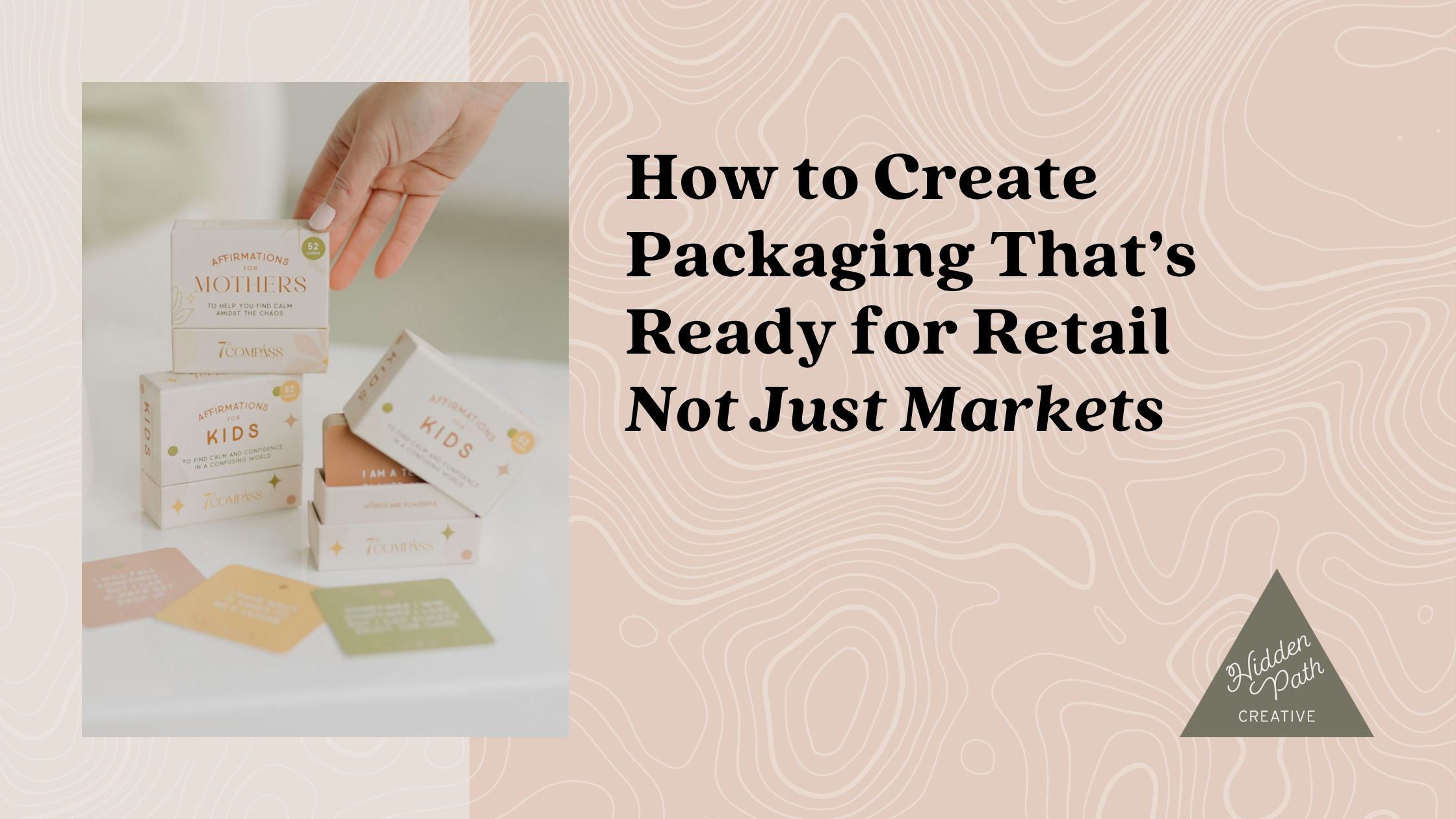
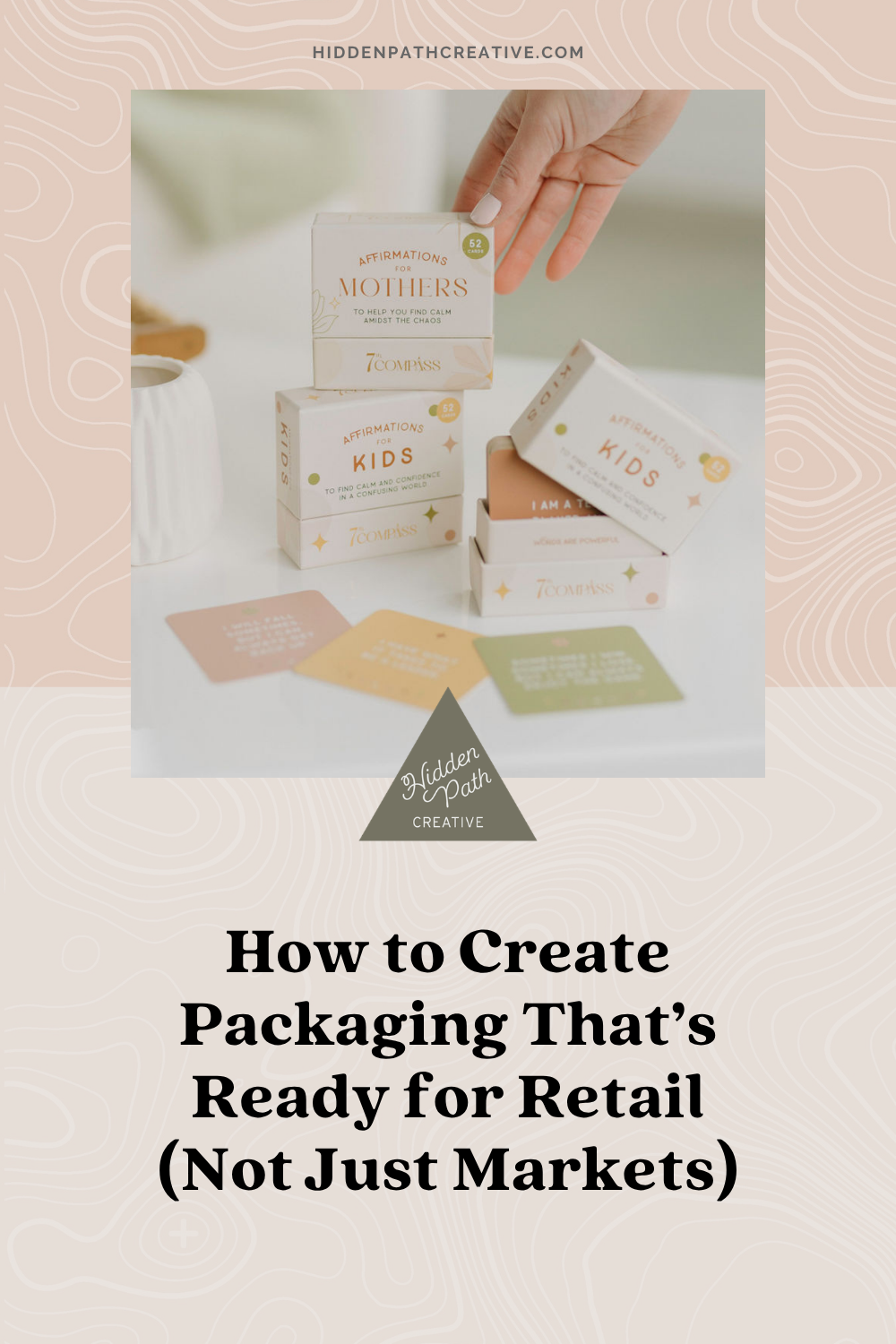
Amy from 7th Compass experienced this exact shift.
Her affirmation cards were doing well at in-person markets because she could stand there and explain the product to shoppers. But in retail settings, people often didn’t immediately understand what the product was without that conversation.
She realized her packaging wasn’t helping the product communicate clearly on its own.
After redesigning the packaging and creating a more cohesive, retail-ready presentation, things started to shift. Retailers began reaching out asking to carry the products, and she started waking up to online orders coming in while she slept.
That’s the kind of momentum many founders are really looking for.
In this post, I’m going to walk you through the three things your packaging must do if you want to grow beyond markets and become more attractive to retailers and wholesale buyers.
Ready? Let’s dig in.
1. Your Packaging Should Work Beyond The Market Booth
Before packaging can market your product, it needs to successfully survive everything that happens before the customer ever gets it. Because when packaging fails, it creates problems that go far beyond a dented box. It leads to refunds, replacements, negative reviews, customer frustration, retailer complaints, loss of trust, operational stress, and costly mistakes that compound as your business grows.
This is one of the biggest shifts that happens when brands move beyond small markets and begin scaling into wholesale, ecommerce, and retail. At markets, you can often catch problems quickly because you’re physically handling the products yourself. But once products are shipped, stocked, fulfilled, shelved, transported, and handled by multiple people, your packaging suddenly has to work much harder.
Your product needs to survive:
shipping
fulfillment
warehouse storage
retail shelving
customer handling
temperature changes
repeated transportation
A beautiful package that leaks, crushes, breaks, dents, or falls apart is still a failed package. And customers usually blame the brand, not the shipping carrier. That’s why packaging protection matters so much more than many founders initially realize. Customers associate packaging performance with product quality. If something arrives damaged or feels poorly protected, it immediately affects how trustworthy and professional the brand feels.
Retailers notice this, too. If products arrive damaged, leak on shelves, break during handling, or cause operational headaches, retailers quickly lose confidence. And when retailers lose confidence, reorders become harder to secure.
That’s why structural packaging decisions are strategic decisions. Protection goes far beyond simply putting a product into a container. It includes selecting the right materials, understanding the product’s weight and fragility, choosing appropriate closures, and considering how the packaging will function throughout shipping, fulfillment, storage, and customer use.
One of the biggest mistakes I see growing brands make is focusing heavily on how packaging looks while overlooking how it performs operationally. But strong packaging needs to do both. It needs to feel polished and professional while also functioning reliably in the real world.
Sometimes, the best solution is not the most custom or complex one. Stock packaging structures are often the better option because they’re already tested, easier to source, lower risk, and far more scalable as the business grows. Then the branding and graphics can elevate the presentation.
The goal is not to create the fanciest packaging possible. The goal is to create packaging that works so well that customers never have to think about it at all. Because when your packaging protects the product properly, everything else gets easier. Customers trust the experience more. Retailers feel more confident carrying your products. Operations become smoother. And your business becomes much easier to scale without constant problems eating away at your time, profit, and momentum.
2. Your Packaging Should Feel Retail-Ready
Packaging is often the very first physical interaction someone has with your brand. Before they try the product, they judge the packaging. And those first impressions happen incredibly fast.
People naturally associate packaging quality with product quality. If the packaging feels cluttered, inconsistent, rushed, or homemade, customers often assume the product itself may be too.
That’s why professional packaging matters so much. It creates confidence before the customer ever opens the product. It helps people feel like the brand is legitimate, established, trustworthy, and worth the price.
This doesn’t mean your packaging needs to be overly fancy or complicated. In fact, some of the strongest packaging systems are actually very simple. The real goal is for the packaging to feel intentional.
Strong retail-ready packaging usually has a clear hierarchy, cohesive branding, consistent typography, thoughtful messaging, and visual consistency across the product line. This consistency reassures your audience that your brand is reliable and professional.
One of the most common issues I see with growing brands is inconsistency that builds over time. Products get designed at different stages of the business, different fonts get introduced, messaging changes, and DIY edits slowly pile up. Eventually, the product line starts feeling disconnected.
While customers may not consciously point out those inconsistencies, they absolutely notice them subconsciously. When visual elements don’t feel cohesive, customers often assume the same lack of care exists within the product itself. That directly affects trust.
Professional packaging also helps your products compete more effectively. Whether someone is looking at your product on a boutique shelf, browsing Faire, scrolling Amazon, or seeing it in a social media ad, they are constantly comparing your packaging to everything around it.
Your packaging should help your product feel like it belongs in those environments. It should feel established instead of homemade. Confident instead of uncertain. Intentional instead of pieced together.
Professional packaging helps customers feel confident in your brand before they ever experience the product itself — and that confidence matters tremendously when you’re trying to grow beyond local markets and into retail.
3. Your Packaging Should Help Customers Understand Instantly
Most shoppers do not read packaging carefully. They are scanning and skimming. Your packaging has only a few seconds to communicate what the product is, who it’s for, and why someone should care. This speed matters far more than most founders realize.
The brain processes visuals dramatically faster than text, so customers form impressions before they even start reading. So it’s important to show shoppers what they need to know. This is where many products struggle. Often, the product itself is actually very good. The problem is that customers don’t understand it quickly enough.
This is exactly what happened with Amy from 7th Compass. At markets, customers would walk up to her booth and ask, “What is this?” Some people even assumed she sold soap because the packaging wasn’t visually communicating the product clearly enough.
Once we redesigned the packaging for quicker, clearer communication, everything changed. Amy’s products became easier to understand at a glance, her brand presentation felt more polished, and she began seeing consistent online sales without needing to explain the product every time. Soon, retailers started reaching out to stock her products.

That’s a huge shift. Because the goal of packaging is not just to look better, it’s to help the product communicate clearly enough to sell more independently.
That’s why founders frequently hear questions like:
“What is this?”
“How does this work?”
“Ohhhh, now I get it.”
If shoppers only understand the product after you explain it, your packaging is creating friction. Many founders respond by adding more information. More text. More explanation. More details. But packaging is not the place for a novel. The issue usually isn’t a lack of information; it’s a lack of clarity.
Strong packaging communicates quickly by using intentional hierarchy, visual cues, recognizable messaging, and clear benefits that shoppers can understand almost instantly. Your packaging should quickly answer four questions:
What is this?
Who is it for?
Why do I need it?
What makes it different?
And it needs to answer those questions fast. The goal of packaging is not to explain every single thing about the product. The goal is to help shoppers understand enough, quickly enough, to want to pick it up, click it, or buy it.
This becomes especially important in wholesale environments. Retail buyers are not just evaluating the product itself. They’re evaluating whether customers will understand the product without requiring constant explanation from store staff. Packaging that communicates clearly creates more confidence for both buyers and shoppers.
The strongest packaging helps customers understand the product quickly enough to feel confident buying it without needing a full explanation from the founder standing beside it.
“But My Product Is Already Selling Fine…”
You might be thinking: “But my product already sells well at markets.” And honestly, that may be completely true. But markets are a very different environment because you are physically there, helping bridge communication gaps in real time. You’re explaining the benefits, answering questions, and helping customers understand the product.
Retail shelves don’t work that way. Wholesale buyers want products that can communicate and sell more independently.
Another common misconception is that customers don’t notice small packaging details, but they do. They subconsciously notice cluttered layouts, inconsistent typography, mismatched design systems, weak hierarchy, and visual confusion. All of those details shape whether the brand feels trustworthy.
The biggest misunderstanding of all is that many founders believe packaging’s job is simply to look good. But retail-ready packaging has a much bigger responsibility. Its job is to protect the product, position the brand professionally, reduce friction, communicate clearly, create desire, and help products sell without requiring constant explanation. That’s what makes packaging strategic instead of purely decorative.
When Your Business Stops Depending Entirely On You
If you want more consistent sales without relying entirely on pop-ups and in-person events, your packaging has to start doing more of the heavy lifting.
Retail-ready packaging helps products feel more trustworthy, more established, and easier for customers to understand quickly. It also helps create the kind of presentation that retail buyers feel more confident bringing into their stores.
When your packaging starts doing its job properly, your business becomes far more scalable. You open doors to:
More wholesale growth.
More discoverability.
Higher perceived value.
Better profitability.
And more freedom in how you spend your time
Because the goal is not just to create prettier packaging, but to build a business that can continue to grow even when you’re not personally standing at a booth selling it.
Ready For Packaging That Does More Of The Selling?
If you are tired of being the one who has to explain your product every time someone picks it up, this is your next move.
Packaging Pronto will help you fix this fast.
In one focused day, we work together to identify where your packaging may be creating confusion, clarify what makes your product valuable and different, and restructure the packaging so it communicates more clearly and professionally.
We look at how your packaging is working for your product from every angle:
how well it protects the product
how professionally it presents the brand
how quickly customers understand it
and whether it feels truly ready for retail and wholesale environments
This is not about starting from scratch or guessing what might work.
It’s about making smart, strategic packaging decisions so your products can feel more polished, trustworthy, and easier to sell.
So your packaging can help your products stand out without you, communicate without constant explanation, and feel ready for retail shelves, Faire, Amazon, boutiques, and wholesale growth.
If that’s the direction you’re ready to move in, the next step is simple.
Book a call to chat through your business and packaging goals.
We’ll look at your current packaging, talk through what may be holding the brand back, and map out what needs to happen to help your products feel more retail-ready and scalable moving forward.